
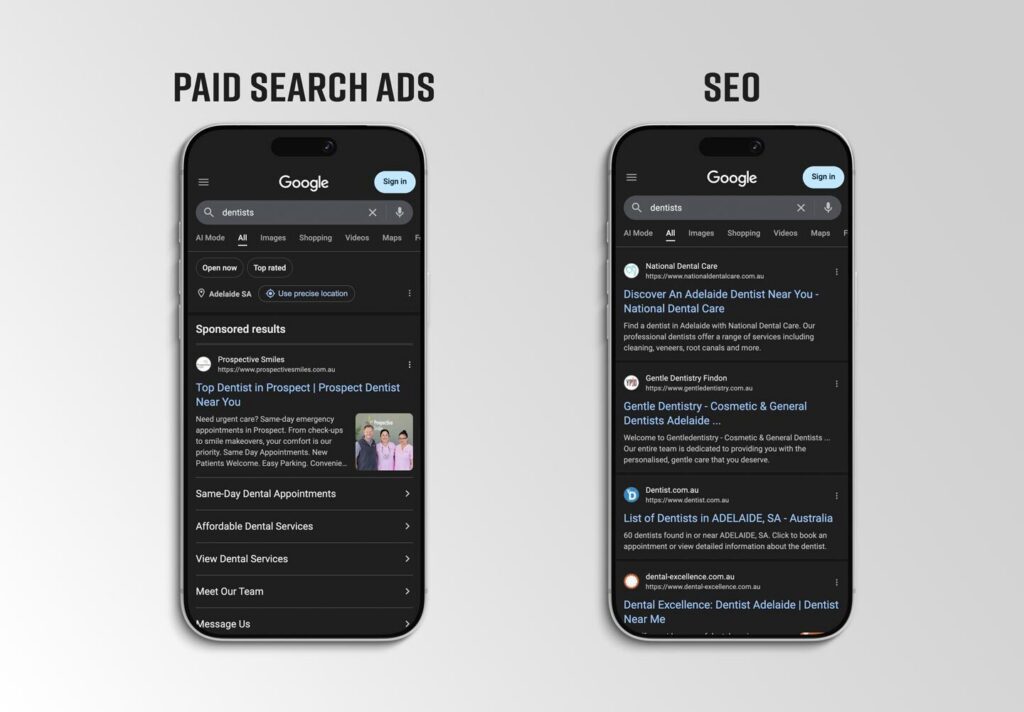
When you’re trying to bring more people to your website there are two strategies that usually come up early in the conversation, SEO (Search Engine Optimisation) and search ads. Both help your business appear in search results and bring in potential customers, but they work in very different ways.
Understanding the difference between them and when to use them can make a big difference in getting the results you’re looking for.
How does SEO work?
SEO, or search engine optimisation, is the process of optimising your website so it appears in the organic results on search engines. These are the listings that appear below the ads and AI overview when you search for something on Google.
Instead of paying to appear in the ads, SEO focuses on making your site relevant to what people are searching for. This involves creating educational and informative content, improving how pages are structured, ensuring your website is technically optimised, and building trust with search engines.
The biggest advantage SEO has over search ads is that it results in consistent traffic over time. A well written article or properly optimised page can continue to attract visitors for years, continuing to bring potential customers to your site long after it’s published.
The downside of SEO is that it rarely delivers instant results. It often takes months before rankings start to improve, especially in competitive industries where many businesses may be competing with you for the same keywords. Google moves slowly with ranking changes and often doesn’t even recognise changes on a site for up to two months.
How do Paid Search Ads work?
Search ads are very different. Instead of waiting for search engines to rank your website naturally, you can pay to appear in the search engine results, often at the top.
For search ads you’ll bid on keywords related to your product or services. When someone searches for those keywords, your ads can appear at the top of the page. If someone clicks the ad you pay a fee, which is why it’s often called “pay per click” or PPC.
Compared to SEO, the biggest advantage of paid search ads is speed. Your campaign can be launched quickly, and website visitors can start rolling in immediately. This makes paid advertising the best choice when you want quick results for things like promoting a new product or you need to generate leads quickly.
The downside to search ads is longevity. Once you stop paying for the ads, the traffic stops as well. You’ll only see results as long as you’re paying Google.
What are the differences between SEO and search ads?
At its core, the biggest difference between SEO and paid search ads is how you get in front of your target audience.
SEO focuses on building long term authority and relevance so search engines choose to rank your pages naturally. The investment normally goes into content, website improvements, and ongoing optimisation. While it takes time to see results, in the long term it often becomes more cost effective as visitors continue to reach your site. However you’re targeting keywords, you can’t target a specific audience.
On the other hand, search ads or pay per click advertising, is built around immediate placement in the search results. Your business pays to appear in front of potential customers straight away. This gives you far more control over targeting, your budget, and the timing of your campaign, but it also means those results disappear when your ads stop.
How do Search ads and SEO work together?
Businesses often treat SEO and search ads as competing strategies, but they often work best when used together.
While an SEO strategy is still gaining traction and building your natural search rankings, paid advertising can be bringing in immediate traffic to your site. Because SEO takes time to build up your rankings, search ads can help fill that early gap and ensure you’re still seeing visitors to your site.
Paid campaigns can also provide valuable information that can be used to strengthen your SEO. Paid ad campaigns can teach you which keywords generate clicks, leads, or sales. You can then use that information to guide content creation for your site and help prioritise topics that are most likely to bring in traffic or convert visitors into customers.
Using both strategies also increases your visibility. When your business appears in both the search ads and the organic results for the same search, your business is taking up more space in the search result. This increases brand recognition and improves the chances that someone will click on your site.
The last advantage of combining SEO and search ads is targeting. SEO targets keywords, you can’t target your audience with it, you’ll show up no matter who searches for your keywords, whether they’re your target audience or not. Paid search ads can be much more targeted, you can optimise your campaign to target specific audiences by location, age, relevancy, or any number of criteria. We’re also only talking about paid ads for search engines here, when you expand to social media you can be even more targeted.
In practice, SEO and search ads serve different roles within a marketing strategy. SEO builds long term visibility and authority, slowly creating a steady stream of organic traffic. Search ads focus on speed and targeting, giving your business immediate results and the ability to reach specific audiences.
Using a combination of the two often gives the best results. Search ads deliver short term results and useful data, while SEO builds sustainable and long-term results.
Don’t choose between one or the other. A full-service marketing agency like Anomaly is well equipped to build and implement a strategy that utilises both paid search ads and SEO for your business. Contact Anomaly today to begin your marketing journey.